

ASAE kept hearing the same concerns from members: policy shifts, funding changes, financial headwinds. But until recently, those were just anecdotes. To find out if these issues were widespread or just coming from a vocal few, ASAE launched pulse polls—quick snapshots from members that captured what was happening in real time. After a year, they published the first State of Associations report in March 2026. The report covers finances, meetings, workforce, advocacy, and AI.
Two numbers stood out to us on first read: over 60% of associations list member retention and engagement among their top three challenges, and nearly half say diversifying non-dues revenue is a top concern. It was the gap between these top two and the rest of the list that we found interesting because the next most common challenge trails at around 25% (domestic political environment).
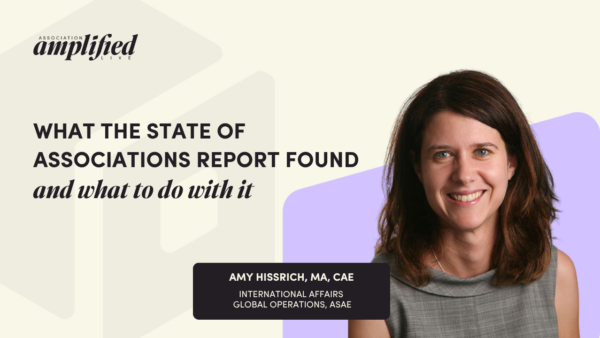
Dan Stevens, President of TaleWind, spoke with Amy Hissrich, ASAE’s Vice President of International Affairs, on an episode of Association Amplified LIVE. Amy led the team behind the report and joined us to share what she saw in the data. A week later, these are the seven takeaways we keep coming back to.
1. Revenue is a downstream outcome.
Amy wasn’t surprised that member retention topped the list of challenges identified by association professionals. To her, that ranking is a sign that they are prioritizing the right things. Associations exist for members, so the simplified flow is: provide value members want, value drives engagement, and engagement produces revenue. As she put it on the show, “revenue is a downstream outcome,” and members are the upstream focus. It also explains why the top two challenges are linked. When value slips, retention and revenue both feel it.
2. Almost everyone is adding. Almost no one is cutting.
When ASAE asked associations under financial pressure what actions they took, most said they were adding, not cutting. Nearly 64% sought new partnerships, and 62% diversified revenue streams. Just over half launched new programs or services. Only 19% cut a program or service, a number that barely changed from last year. The report calls out the imbalance: sunsetting programs is one of the hardest moves for associations.
3. Sponsors want to be involved.
The sponsorship model is changing, and Amy has seen both sides. She started her career as an industry partner. Sponsors now want long-term relationships built on trust, shifting away from transactional offerings like logo placements and invoices. They see themselves as part of the community—problem solvers who want to co-create for members and be recognized as thought leaders.
For associations, this shifts the pitch from selling inventory to building relationships.
4. AI handles the information. The trust remains human.
Nearly 88% of associations now use AI for content creation, almost double the number using it for data analysis. Amy said she used to see a core association value in synthesizing and analyzing member information and sharing it back with the group. Now, AI does that job well.
Her example from the show: AI can take 500 pieces of disparate information and surface the three most common themes. What it can’t do is identify the challenges members are facing or the solutions they’re trying to implement. “What AI can’t do yet is that convening part,” she said. It can’t replace the association’s role as the trusted, vetted source of information.
5. Be the source AI cites.
When asked how associations keep their value visible as members turn to AI for answers, Amy said this goes beyond the report’s data. Her answer is an opinion, informed by years of working in technology before moving into international relations.
Her advice: know what belongs in the public space and what stays member-only. For everything public, make sure your association is credited in the answers AI tools provide. If someone never visits your website but the right information reaches them with your name on it, the association is still doing its job. “I would see it less competing with, but still being the steward of and the source of,” she said. A competition mindset, she added, is going to be really tough.
6. Entry-level jobs aren’t disappearing.
Dan asked Amy what surprised her in the data. Her answer: staffing. Headlines predict entry-level jobs will be the first to go as AI grows. ASAE’s polling found the opposite. Entry-level positions were most likely to see increases, reported by 46% of organizations, and some of the least likely to be cut, at 19%.
Amy called the finding heartening. Her concern is for the next generation of talent. Associations need to onboard people early to develop future board members and committee chairs.
7. The boldest move might be a pause.
Before the audience Q&A, Dan asked Amy what one thing associations could do today, based on the report. Amy’s answer went in a different direction. The report shows a sector innovating with new programs, partnerships, and revenue models, which she finds encouraging. But she noticed little sunsetting.
“It’s harder to stop doing than it is to start doing,” she said. Her answer to Dan’s question was to pause. After 12 to 18 months of reacting to a shifting environment, she hopes associations will take a breath, look strategically at everything they run, and ask whether each piece still delivers value to members.
The full conversation is on demand, and you can find more insights in the episode.