
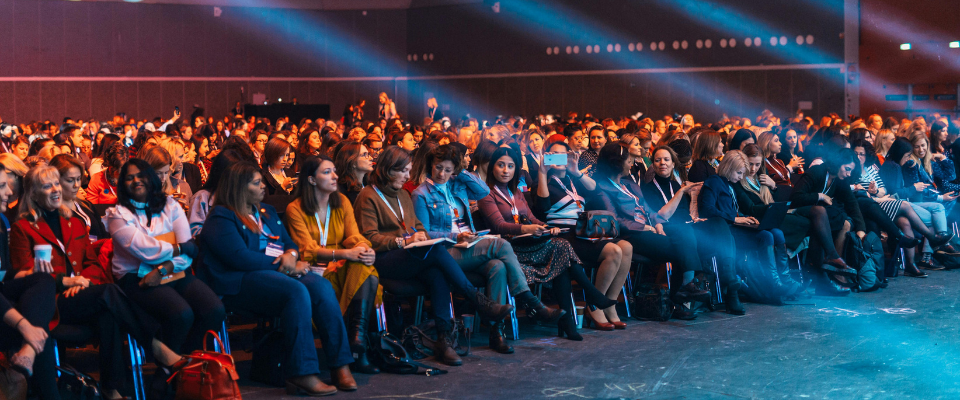
Your annual event is one of the most content-rich moments your association creates all year. Speakers, sessions, conversations, expertise—all of it concentrated in one place, for a few days. So the question is, what do you do with it after the closing keynote?
MHI—a trade association serving the supply chain and material handling industry—has been answering that question for over a decade. What began as an effort to make their annual report more digestible has grown into a year-round association content strategy that publishes every week, funds digital sponsorships year-round, and runs without adding a single person to their team.
That’s what happens when an event is treated like part of your content system.
The Association Event Content Problem
Most associations see a predictable pattern around their events: registration climbs, attendance peaks, engagement spikes—then drops off sharply two or three weeks later. The calendar goes quiet until the next big moment.
It’s easy to attribute this to member behavior. In reality, it’s usually a content problem.
Association event content is typically built for documentation, not programming. The replay gets posted. The recap goes out in the next newsletter. A few photos land on social. Those are all fine—but they’re one-and-done formats. They don’t create a reason for members to come back next week or the week after.
The associations that stay visible year-round are getting more out of their events by deciding how the content will be used before anyone books a flight.
If you’re looking for the tactical side of this—what formats to capture, how to structure your footage—The Anatomy of an Effective Event Recap Video and How to Turn Event Footage Into High-Impact Video Content are good starting points.
What a Year-Round Association Content Strategy Actually Looks Like
Think about who’s in the room at your annual event. Speakers, subject matter experts, industry leaders—people who are normally scattered across the country, suddenly all in one place for three days.
That’s your content calendar, if you plan for it.
Book 20 interviews on-site. Capture experts while they’re energized, in person, already thinking about the industry. Then release those conversations steadily over the following months—one every few weeks, tied to topics your members actually care about.
It’s the same logic as a family portrait. You don’t schedule a separate session for every family member. You take the photo at Christmas, when everyone’s already in the room. The event is your Christmas. The interviews are the portrait.
Do this consistently, and your association content strategy runs on what you’ve already captured—not on chasing people down remotely for months afterward. At MHI, the sponsors who participate in year-round content come back year after year—and their videos consistently rank among the highest-performing with the audience. That’s what happens when the content, the audience, and the sponsorship are all pointed in the same direction.
From Event Recap Videos to a Content Engine
When MHI arrives at MODEX—one of the largest supply chain and material handling trade shows in North America—they don’t show up with a camera and a hope. They show up with a production plan.
In April 2026, that meant 3 daily recaps, 14 look lives, 12 vertical spotlight videos, 5 audio podcasts, and 5 award videos captured and edited on-site—plus conference hype videos and an event promo produced ahead of time to build anticipation. Forty videos and five podcasts in total, built around a single event.
But the number that matters most for what comes next: 32 interviews captured on-site with industry experts and subject matter leaders. Those don’t all go live at the event. They become the raw material for months of content afterward—videos, podcasts, and programming released steadily throughout the year.
That’s the shift. Pre-event assets drive attendance. On-site capture creates the immediate content. Interviews feed the system long after the show floor goes dark.
What This Requires (And What It Doesn’t)
The natural reaction to a content operation like MHI’s is to assume it requires MHI’s resources. It doesn’t.
The underlying principle scales down without losing its logic. If you have a regional conference with 400 attendees and five speakers worth putting on camera, that’s five interviews. Release one a month, that’s five months of content you didn’t have before. Plan for ten, and you’ve covered most of your year.
The shift isn’t about volume. It’s about intention. Showing up to your event with a list of people you want to capture—and a plan for what those conversations will become—is what separates associations that leave with footage from associations that leave with a content calendar.
Most associations don’t handle the production side in-house, and they don’t need to. The part that belongs to your team is smaller than you’d think: know who you want to talk to, know what topics matter to your members, and show up ready. The logistics of capturing, editing, and releasing that content on a consistent schedule is where an outside partner earns their place—freeing your team to stay focused on strategy and member relationships.
The investment is real. But so is what you get back: content that works for months, not days.
Turn Your Next Event Into a Year-Round Content Strategy
Your next event is already on the calendar. The speakers are being confirmed, the agenda is taking shape, and your team is deep in logistics. This is the time to plan how you can extend the impact.
Your event is the raw material. What would you like to make with it?