


Most association leaders will tell you their budgets are stable. And they are—until they’re not.
The traditional model still works. Events bring people in. Membership dues provide steady income. Sponsors continue to invest. But when 62% of association leaders call event dependency their biggest vulnerability, as the Association Forum’s FIRE Report Brief shows, something has changed. Financial stability is there, but the foundation feels more fragile than ever.
The truth is, the industry has been diversifying for decades. ASAE data shows membership dues dropped from 95.7% of total association revenue in 1953 to just 30% for professional associations and 45.4% for trade associations by 2016. That’s progress—except many associations replaced one dependency with another. Instead of relying on dues, they now lean heavily on events. Different concentration, same risk.
The FIRE Report Brief confirms what most leaders already sense: 78% describe their budgets as “stable but cautious.” That word, cautious, says it all. Leaders know the model works for now, but they aren’t sure it will hold up when tested.
The goal is to spread value across time, channels, and audiences, so you reduce risk without weakening your core programs. Adaptive revenue models do just that. They build on your strengths instead of forcing you to start from scratch.
What follows is a framework for diversification that accounts for capacity constraints, addresses real barriers, and reduces long-term risk. We’ll explore what adaptive revenue models actually look like, why content sits at the center of digital revenue growth, and how to take the first steps without overwhelming your already-stretched team.
Understanding Event Dependency (And Why It Persists)
Events work. That’s the simple truth. They deliver concentrated value in a way members understand and appreciate. The experience is tangible, the value is recognized, and for most associations, the financial return justifies the massive investment of time and resources.
The common saying is “if it ain’t broke, don’t fix it,” but do you really want to wait until something breaks before you work on a backup plan?
The 2020 Wake-Up Call
The pandemic forced everyone’s hand. Associations scrambled to move programming online. Some pivots worked well enough to keep the doors open. Others exposed uncomfortable realities: fragmented content scattered across platforms, no real digital infrastructure, and zero systems for delivering ongoing value outside of the annual conference cycle.
What’s changed since then? Some associations invested in digital platforms and hybrid event models. The FIRE Report Brief shows that 82% of leaders now want hybrid access to learning and events, and partners rank hybrid as their top brand-activation channel. But many others went back to business as usual when in-person events returned, still carrying the same vulnerabilities.
The Real Risks
Event dependency doesn’t show up as a sudden crisis. It chips away at your flexibility over time. By the time attendance drops or a major sponsor leaves, your options are already limited.
When your revenue depends on specific moments, you’re exposed to everything outside your control:
- Economic uncertainty that shrinks travel budgets overnight
- Members who now expect convenience and on-demand access
- Sponsors demanding year-round visibility and measurable ROI
- Competition from other events, digital alternatives, and the reality that fewer people have the bandwidth to attend
Industry research confirms this: revenue instability from fluctuating event fees and attendance is one of the top financial risks for associations. Events are still valuable, but they are riskier as your main revenue source.
Why Diversification Efforts Stall
Most leaders understand the need to diversify. The FIRE Report Brief shows that 71% of organizations see capacity constraints as their top operational risk. When your team is already at capacity, launching new digital initiatives can feel like too much.
Other barriers show up too:
“We’ll cannibalize our events”—It’s a common concern: that offering digital content will reduce annual meeting attendance. But industry data points in the opposite direction. ASAE benchmarking from 2018 shows that, on average, roughly 30–40% of members attend an association’s annual meeting, meaning the majority of members are already engaging outside the event.
Diversifying revenue isn’t about chasing a quick financial win—it’s about building a sustainable model that serves members year-round. Digital engagement doesn’t replace events; it strengthens them by expanding reach, maintaining momentum between touchpoints, and giving more members a reason to stay connected long before registration opens.
“We tried digital before, and it flopped.”—Fair. But those failures usually come down to three things: the content existed, but no one could find it, the technology was clunky, or digital was treated as a side project instead of a real strategy. Research shows that roughly 70% of digital transformation initiatives still fail to meet their objectives, but it’s because of organizational and adoption challenges, not the technology itself.
Organizational silos—When marketing, membership, and education all operate in their own lanes, digital initiatives struggle. Content lives with one team, sponsorship with another, member engagement with a third. No one owns the whole experience, so nothing gets traction.
Everyone knows what needs to change, but aligning cross-departmentally can feel overwhelming and out of reach.
Stability is not the same as resilience. Your budget can look stable on paper, but still be vulnerable. Resilience means having more than one way to deliver and capture value. That’s where adaptive models help.
What “Adaptive Business Models” Actually Mean
An adaptive business model is simply a way to organize how you deliver value and generate revenue that fits how your members engage today.
Adaptive vs. Transformational
Adaptive does not mean starting from scratch. That’s transformational change—high-risk pivots, replacing core operations, or betting everything on something new.
Transformation says: Shut down your annual conference and go digital-first.
Adaptation says: Keep your conference strong. Add year-round digital engagement to drive attendance and create new revenue streams.
The Three Characteristics of Adaptive Revenue Models
If you look at associations that have successfully diversified, three patterns emerge:
Multiple revenue streams that balance ongoing value
You are not just adding more income sources for added revenue. You are balancing your non-dues sources so they’re not tied to one single source, like your conference. This way, you would have income that comes in all year, like subscriptions or sponsored content. This way, if your events one day do earn less, it can be made up elsewhere.
Digital infrastructure that scales without burning out your team
This is where technology proves its value. A well-organized content library can serve thousands of members without manual effort. Automation, self-service access, and centralized platforms reduce workload and expand your reach. The right systems help your team do more, not work harder.
A member-centered approach that matches how people actually consume value
Members do not engage the way they did ten years ago. They want on-demand access and personalized recommendations. Adaptive models meet people where they are, not where the calendar says they should be.
Mapping Your Revenue: Where Are You Concentrated?
Think about your revenue across two dimensions:
Event-Based vs. Ongoing—Does this income come from a specific moment in time, or does it flow continuously throughout the year?
Physical vs. Digital—Is this revenue tied to in-person experiences, or is it delivered through digital channels?
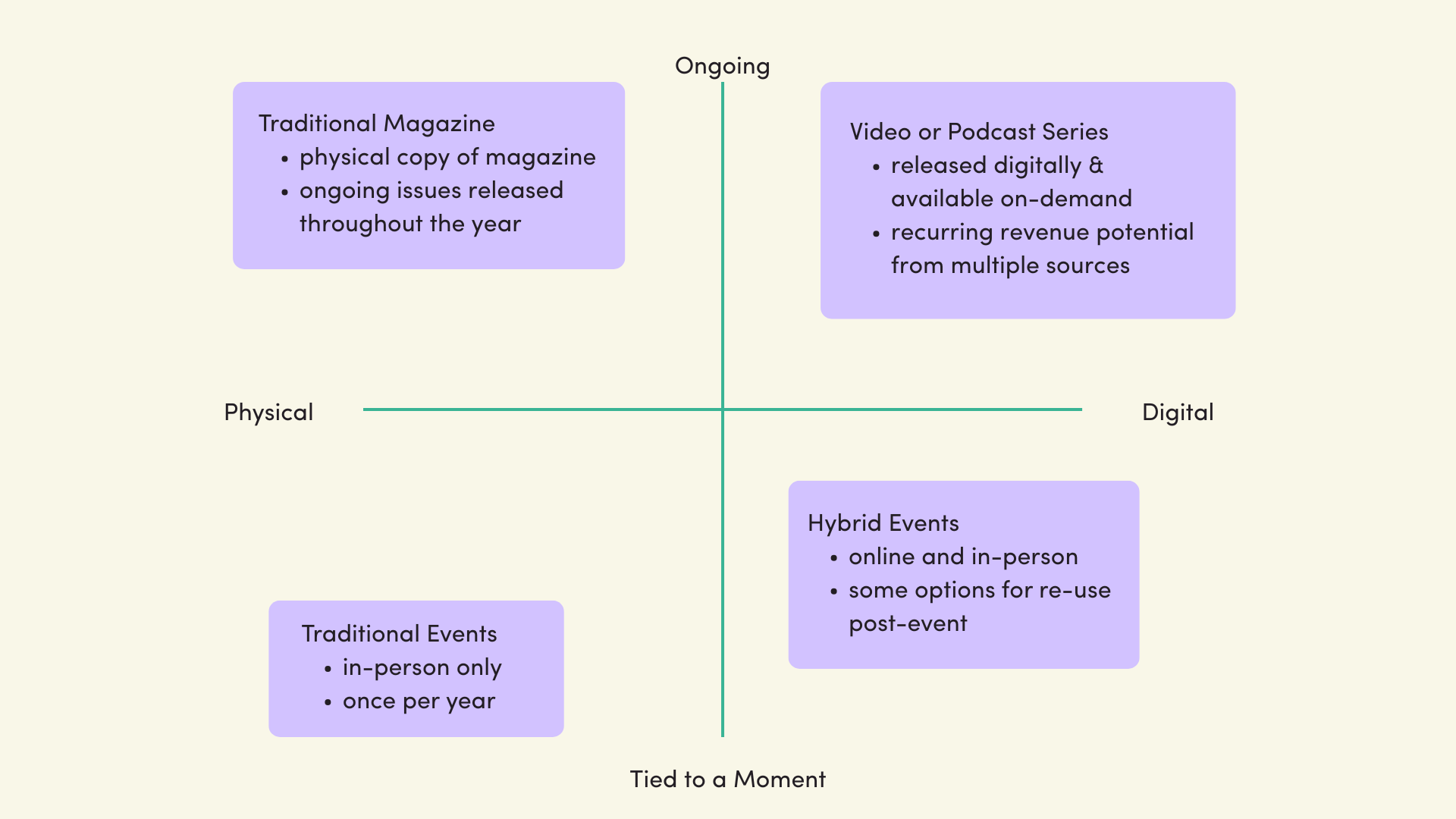
Most associations start with revenue concentrated in Event-Based and physical activities: the annual conference, maybe a few regional events. This is the most vulnerable spot because everything depends on those moments going well.
Adaptive models move into other areas, especially Ongoing and Digital. This is where you find the most scalability and the least dependency on any single event.
The question is not whether events are valuable. It’s whether you can afford for them to be your only engine.
For example, an association with 80% event revenue might shift to 60% event-based income, 20% digital subscriptions, and 20% sponsored content. Event attendance doesn’t drop—in fact, it often increases because year-round digital engagement keeps the association top-of-mind and strengthens member relationships.
Why Content Sits at the Center of Digital Revenue
You are already a publisher, even if you do not think of yourself that way. You produce webinars, articles, podcasts, videos, research reports, and event recordings. The challenge is not a lack of content. The challenge is that your content is scattered.
Some content lives on YouTube. Some sits behind your member portal. Some is buried in old email archives. When content is scattered, its value is hidden. And when value is hidden, revenue opportunities vanish.
The Visibility Problem
Most associations drastically underestimate how much valuable content they already have. Take your annual conference alone—dozens of session recordings, keynote presentations, panel discussions, speaker interviews. Add monthly webinars, quarterly publications, and ongoing professional development resources. The volume is significant.
But if members do not know it exists and sponsors cannot see their investment, it might as well not exist.
Three Ways Content Becomes Revenue
Subscription and Membership Enhancement
You can offer tiered access to premium content, creating digital-only memberships or enhanced subscriptions. This does not replace traditional membership. It extends it. Members who cannot attend in-person events still have a way to engage. Those who want deeper access to specialized content can pay for it. You generate predictable, recurring revenue.
And the opportunity is real. Research on the online learning market projects that the sector will reach $400 billion by 2026. Your members—ambitious professionals constantly looking to level up their careers—are already spending money on learning. The question is whether they’re spending it with you.
Sponsorship
Sponsors want visibility, engagement, and measurable ROI. When your content is organized into topic-based collections or themed libraries, sponsorship value increases exponentially.
Instead of selling logo placement on a single webinar, you can offer sponsorship of an entire content series, a curated learning pathway, or a branded hub that positions their brand alongside relevant industry insights, which frames the sponsor as an expert in the field, building trust with potential customers.
Visible, well-organized content makes this possible.
Pay-Per-Access
Archived content libraries, certification prep courses, and specialized training modules can all be monetized on a pay-per-access basis. Members or non-members who need specific resources can buy them individually without joining. This is a low-friction entry point that often leads to long-term engagement.
Why Content Scales Better Than Events
The key advantage is that content is not tied to a single moment. Once you create it, hundreds or thousands of people can access it without extra production costs.
That keynote from your annual conference can become a sponsored video series, social media clips, articles, and part of a learning pathway. You do not need to ask the speaker to return and record more.
Associations that have reorganized their existing content into searchable, topic-based libraries often see significant increases in sponsor interest. When content becomes discoverable and strategically organized, sponsors can finally see the year-round engagement opportunities they’ve been looking for.
The Implementation Framework
Moving toward adaptive revenue models is not an overnight change. It is a phased process: understand what you have, organize it, test new approaches, and scale what works.
Phase 1: Audit & Assess (Weeks 1-4)
Start with clarity. Before you launch anything new, you need to know where you stand.
Audit your revenue sources—Break it down by category: membership dues, events, sponsorships, digital offerings, certifications, publications. What percentage comes from each? Where’s the concentration risk?
Take inventory of your content. What do you already have? Where does it live? Who can access it, and how easy is it to find? This is not about counting videos. It is about knowing whether your content is organized to support discovery and engagement.
Ask your members what they actually need—What problems are they trying to solve? What information do they need throughout the year, not just at your conference? Understanding demand helps you prioritize which content to feature and how to package it.
Separate quick wins from long-term projects. Some improvements take weeks, like reorganizing a content library. Others take months, like building a full digital platform. Identify both so you can build momentum while planning for bigger changes.
Phase 2: Organize & Centralize (Months 2-3)
Once you know what you have, make it accessible.
Create a unified content destination. Members should not have to search across multiple platforms. A centralized digital hub, whether it is a branded content platform, an enhanced member portal, or a media library, makes content easy to find and positions you as an ongoing resource, not just an event organizer.
Organize by topic, not format. Most associations sort content by type: webinars here, articles there, videos somewhere else. But members search by topic. If someone needs information on leadership development, they do not care if it is a video, article, or podcast. They care that it solves their problem. Organizing by topic matches how people actually look for information.
Set up basic analytics. You can’t improve what you don’t measure. Track which content gets consumed, how long people engage, and what drives repeat visits. This data informs your future content strategy and helps you demonstrate value to sponsors.
Decide whether to build or buy. Some associations have the internal capacity to build custom solutions. Most do not. Consider if investing in a purpose-built content platform makes more sense than piecing together existing tools. The right technology should reduce workload, not add to it.
Phase 3: Test & Learn (Months 4-6)
Before you scale new revenue models across your entire organization, test them in a controlled environment.
Launch one pilot program. Pick one content collection, one sponsor, one member segment. Keep the scope manageable. This could be a sponsored learning pathway, a premium subscription tier, or a pay-per-access certification course. The goal is to gather feedback and iterate quickly.
Experiment with pricing. What are members willing to pay for? What do sponsors value most? Try different approaches: tiered subscriptions, bundled access, sponsored content, or a la carte pricing. You do not need to get it perfect on the first try. You are learning what works.
Actually listen to feedback. Ask members and sponsors what worked and what didn’t. Use their input to refine the offering before you expand.
Track the metrics that matter. Content consumption rates (views, time spent, completion rates), member satisfaction scores, sponsor inquiry and engagement rates, and revenue per member.
Phase 4: Scale & Optimize (Months 6-12)
You’ve validated an approach. Now expand it.
Replicate what worked: If a sponsored content series succeeds with one partner, do it with others. If a premium subscription tier gains traction, add more content and promote it more widely.
Build repeatable systems: Create templates, workflows, and standard operating procedures. These models should run efficiently without requiring custom effort every single time.
Train your team: Digital revenue models regularly require skills different from those of event-focused operations. Make sure your team knows how to manage content, engage sponsors in new ways, and analyze performance data.
Communicate clearly: As you expand digital offerings, both members and sponsors need to understand what’s available and why it matters. Clear communication increases adoption and reduces friction.
Watch for these signs of success: A more diversified revenue mix, increased digital engagement with more frequent member touchpoints, improved member retention as digital access reduces churn, and higher sponsor satisfaction and renewal rates.
What’s Realistic for Small Teams?
Not everyone has a large staff or unlimited budget. Start small and scale as capacity allows.
With 1-2 people: Focus on organizing existing content and launching one pilot program. Use technology to automate as much as possible. Outsource production or platform management if internal resources are limited.
With a larger team: You can run multiple pilots simultaneously, invest in more sophisticated analytics, and build custom workflows.
The build vs. outsource question: Some associations want to develop internal expertise. Others find it more efficient to partner with specialists who already have the systems and experience. The right choice depends on your long-term strategy and available resources.
Technology should help, not add complexity: The best platforms simplify operations. Look for solutions that centralize content management, automate member access, track engagement, and integrate with your existing systems. If a tool needs constant manual work, it is not the right tool.
Overcoming Internal Barriers
Even with a clear plan, internal resistance can stall progress. The objections sound reasonable on the surface, but they often reflect outdated assumptions rather than current realities.
“We Don’t Have the Capacity”
This is the most common barrier, and it is real. Teams are stretched. But the real question is not whether you have capacity now. It is whether you can afford not to build it.
Start with the smallest viable step. Reorganizing a content library doesn’t require a full-time hire. Testing one sponsored content series does not need a new department. Adaptive models work because they build up over time, not all at once.
“We’ll Cannibalize Events”
The data consistently shows the opposite. Digital engagement drives event attendance by keeping you visible and relevant throughout the year. Members who engage with your content regularly are more likely to attend in-person events, not less.
Consider this: a member who only hears from you once a year is less invested than one who engages every month. Digital touchpoints build stronger relationships. They make the annual event more valuable, not less.
“We Tried Digital Before, and It Didn’t Work”
Past failures usually stem from three issues:
Fragmented approach—The content existed, but it wasn’t organized or promoted strategically.
Wrong technology—The platform was clunky, hard to use, or didn’t integrate with existing systems.
No clear strategy—Digital was treated as an add-on rather than a core part of your member value proposition.
Adaptive models succeed because they solve these root problems. Content is centralized. Technology is sourced or built for a specific function. And strategy is woven into your larger organizational vision.
Breaking Down Organizational Silos
When marketing, membership, and education teams work in silos, digital initiatives struggle. Content sits with one team, sponsorship with another, and member engagement with a third. No one owns the full experience.
You don’t need to restructure your whole organization. Start by aligning teams around a shared goal: delivering consistent member value. Regular cross-functional meetings, shared dashboards, and collaborative planning create the coordination needed to make digital revenue models work.
Getting Buy-In from Leadership
Board members and staff may resist change, especially if the current model feels stable. The key to buy-in is to show the risk of doing nothing, not just the benefits of change.
Frame the conversation around sustainability: “Our current model works today, but it leaves us vulnerable. If attendance drops by 20% or a major sponsor pulls out, how quickly can we recover?”
Most boards understand risk. Show them the concentrated exposure, and the conversation often shifts from “Why should we do this?” to “How soon can we start?”
For staff, emphasize that adaptive models reduce pressure, not add to it. Automated systems, centralized content, and repeatable processes make work more manageable.
Measuring Success
Adaptive revenue models take time to grow. The metrics you track in the first six months will look different from what you measure after a year. Some metrics show progress early (leading indicators). Others take longer to materialize (lagging indicators). Knowing the difference between these two can help you set realistic goals.
Leading Indicators (0-6 Months)
These are early signals that your strategy is working, even before revenue shifts significantly.
Content consumption rates: Are members accessing digital content? How often, and for how long? Higher engagement means you are meeting a real need.
Time spent on digital platforms: If members spend more time on your site or content hub, they are finding value. This is a strong sign of long-term retention and revenue growth.
Member feedback scores: Direct feedback shows whether changes are working. Positive survey responses or direct comments mean you are moving in the right direction.
Sponsor inquiry rates: If sponsors ask more questions, show interest in new opportunities, and engage more often, your digital presence is creating value that they notice.
Lagging Indicators (6-12+ Months)
These metrics reflect the long-term impact of your strategy.
Revenue diversification percentage: How has your revenue mix changed? If event dependency drops from 80% to 60%, you have reduced concentration risk.
Digital revenue as a percentage of total: Track how much income comes from digital subscriptions, sponsored content, pay-per-access, and other non-event sources. Growth here shows your adaptive model is working.
Member retention rates: Are members staying longer? Higher retention means year-round engagement is strengthening your value.
Sponsor renewal rates: Sponsors who renew and increase their investment show that your digital offerings deliver measurable ROI.
Cost per member served: As digital infrastructure grows, the cost to deliver value per member should go down. You reach more people without raising expenses in proportion.
A Simple ROI Framework
Here’s how to calculate the return on your investment in adaptive revenue models:
ROI = Net Revenue / Cost of Implementation
For example: spend $50,000 building a digital content platform, generate $80,000 in new sponsorship and subscription revenue in the first year—that’s a 60% ROI.
But ROI is not just about money. Consider risk reduction, member satisfaction, and operational efficiency. These benefits add up over time, making the long-term ROI even stronger.
What Success Looks Like
Adaptive revenue models don’t just change the numbers—they change how your organization operates and how members experience value.
Consider what happens when an association moves from 75% event dependency to a more balanced model: 50% events, 30% digital, 20% other revenue sources. The shift takes 18 months, but the transformation is significant.
What changes for members: Access to valuable content becomes year-round, not just during the annual conference. Digital learning pathways help them build skills on their own timeline. The association becomes more present and relevant in their day-to-day work.
What changes for staff: Revenue becomes more predictable. Instead of scrambling to hit annual event targets, teams have consistent income streams that allow for better planning. Digital systems reduce manual work, freeing up time for strategic initiatives.
What changes for sponsors: They gain year-round visibility. Sponsored content series, branded learning hubs, and data-driven performance reports give them clearer ROI. Sponsorship renewals increase. Average investment per sponsor grows.
The compounding effect: Digital revenue doesn’t compete with events—it strengthens them. Members who engage with digital content year-round are more likely to attend in-person. Sponsors who see consistent engagement through digital channels invest more heavily in event activations. Better digital systems free up staff to deliver higher-quality events.
The model becomes self-reinforcing. Digital drives events. Events generate content. Content attracts sponsors. Sponsors fund more digital infrastructure. The cycle continues.
Your Next Steps
The shift from event-dependent to adaptive revenue models takes 12 to 18 months. It is not a quick fix. Every month you wait is another month of concentrated risk.
The mindset shift is simple. Stop asking how to do more. Start asking how to organize what you already have.
Most associations do not need to create more content. They need to make what they have more accessible, more visible, and better aligned with member needs and revenue opportunities.
First Action: Understand Where You Stand
Before you launch new initiatives, get clarity on your current digital presence. What’s working? What’s harder for members to find? Where are the gaps in visibility, engagement, or revenue potential?
Remember This
Adaptive models build on what works. They do not replace proven programs. They extend them. They do not need transformation. They need strategic organization and steady action.
The reality is this takes time. But the associations that start now will be the ones positioned for resilience, growth, and long-term sustainability.
The choice is not between stability and change. It is between stability and resilience. Resilience comes when you design for the future, not just react to it.